

Fantasy football doesn’t care about reputation. It doesn’t care about five-star recruits, historic championships, or media hype. It only cares about one thing: on-field field.
“Every yard. Every touchdown. Every reception. Every rush.”
And when you add all of that together across the NFL season, you get a number that tells a brutally honest story: Fantasy Points.
Now here’s where it gets interesting.
When you trace those fantasy points back to where the players came from their colleges, a powerful pattern appears. Some schools are not just sending players to the NFL. They are sending players who drive fantasy leagues, score touchdowns, and carry offenses.
Using official 2025 season data from the Season Offense table on Alumni Tracker, we analyzed which colleges produced the highest total fantasy football impact across the league.
The results reinforce the dominance of traditional power programs while revealing meaningful differences in how schools translate talent into fantasy production.
The Data Behind This Ranking
This ranking is based entirely on the Fantasy Points earned by Alumni from each college a collection of their stats throughout the season.
-
- Passing yards and touchdowns
- Rushing yards and touchdowns
- Receiving yards and touchdowns
Here are the colleges whose alumni generated the most fantasy points in the 2025 NFL season:
| Rank | College | Fantasy Points (FantPt) |
|---|---|---|
| 1 | Alabama | 2,064 |
| 2 | Ohio State | 1,612 |
| 3 | Oklahoma | 1,325 |
| 4 | Oregon | 1,158 |
| 5 | USC | 1,151 |
| 6 | Georgia | 1,047 |
| 7 | Stanford | 1,015 |
| 8 | North Carolina | 980 |
| 9 | Notre Dame | 865 |
| 10 | Penn State | 840 |
| 11 | Clemson | 838 |
| 12 | LSU | 830 |
| 13 | Texas | 799 |
#1 Alabama — The Ultimate Offensive Pipeline (2,064 FantPt)
Alabama alumni didn’t just lead this ranking; they dominated it across every offensive category.
With 7,830 passing yards, 4,600 rushing yards, and 5,653 receiving yards, Alabama’s former players generated production in every phase of the offense.
That balance explains why Alabama’s fantasy output sits far ahead of every other school. Rather than specializing at one position, the program consistently produces complete offensive talent:
- Quarterbacks who move the ball
- Running backs who finish drives
- Receivers who create explosive plays

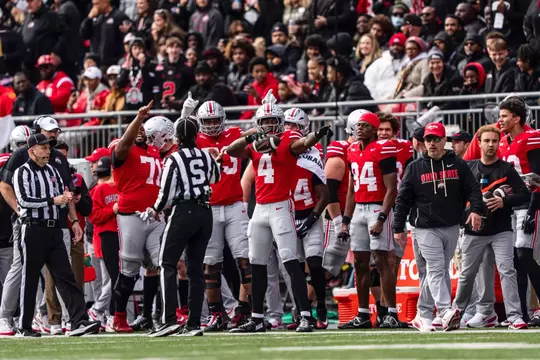
#2 Ohio State — The Receiver Factory That Wins Fantasy Leagues (1,612 FantPt)
Ohio State’s strength shows up clearly in the data, led by 6,412 receiving yards and 41 receiving touchdowns, production that drives consistent fantasy scoring.
While Ohio State alumni also contribute through the air and on the ground, it is the program’s elite wide receiver output that elevates the Buckeyes into second place overall.
As a result, Ohio State alumni are among the most reliable weekly fantasy contributors across the league.
(Ohio State Alumni Performance page)
#3 Oklahoma — Quarterback-Driven Fantasy Production (1,325 FantPt)
Oklahoma stands out for a different reason. They recorded 8,816 passing yards and 64 passing touchdowns, both among the highest in for the 2025 season.
This tells a clear story: Oklahoma alumni quarterbacks are major fantasy contributors.
Even with lowerer rushing totals, the passing production alone drives their fantasy score high.
#4 Oregon and USC — Explosive, Balanced Offenses
Both Oregon (1,158) and USC (1,151) show a similar pattern:
- Strong passing
- Effective receiving
- Enough rushing contribution to stay balanced
These schools don’t rely on one position. Their alumni contribute across the offense, making them consistent fantasy producers.

(Pac-12 Alumni NFL Impact page)
#5 Georgia — Skill Position Dominance Drives Fantasy Production (1,047 FantPt)
Georgia’s data stands out for a different reason. While Georgia alumni recorded no passing production in this dataset, they still surpassed 1,000 fantasy points through dominant rushing and receiving output.
How?
- 3,357 rushing yards
- 4,128 receiving yards
- 51 total touchdowns (rush + receive)
This is pure skill-position dominance. Georgia alumni are the running backs and receivers finishing drives.
(Georgia Alumni Performance page)
What this Data Shows for Fans and Programs
This data isn’t meant to change how fantasy managers draft players. Instead, it highlights how consistently certain college programs translate talent into real NFL production.
When fans see players from Alabama, Ohio State, Oklahoma, Oregon, or USC scoring touchdowns on Sundays, this data helps explain why. These programs don’t just send players to the league, they send players who are regularly involved in offensive production.
For alumni and college football fans, fantasy points offer a measurable way to compare how programs stack up once players reach the professional level.
Conference Patterns Within the Data
When fantasy production is grouped by conference, clear patterns emerge:
-
SEC programs (Alabama, Georgia, LSU) account for a large share of total offensive output
-
Big Ten programs (Ohio State, Penn State) remain consistent contributors
-
Historic power programs (USC, Oklahoma, Texas, Notre Dame) continue to produce high-impact offensive talent
These conferences aren’t just represented on NFL rosters — their alumni are central to offensive production across the league.
SEC vs Big Ten comparison article)
Final Takeaway
Fantasy points don’t exist for bragging rights — but they do provide a clear, objective way to measure offensive impact.
In the 2025 NFL season, alumni from Alabama, Ohio State, and Oklahoma led the league in total fantasy production, with Oregon and USC close behind.
For fans and alumni, fantasy production offers a clear way to see how college programs continue to influence the NFL long after Saturdays end.