
The first round of the 2026 NFL Draft told you a lot about what NFL teams still pay for. Offensive linemen flew off the board. Pass rush kept getting bought early. Tight ends came off fast, too. But the moment people will remember most was not a tackle or an edge rusher. It was the Rams taking Alabama quarterback Ty Simpson (Rams) at No. 13 while Matthew Stafford (Rams) was coming off an MVP season and a one-possession loss to Seattle in the NFC Championship Game. NFL teams spent this weekend planning for what is next as much as what is now.
That is what makes this kind of school-by-school look useful. Draft totals by themselves are easy. Anybody can count picks. The better question is what those draft classes landed on top of. If a program already had real starter-level weight in the league and then stacked another strong class behind it, that is where the pipeline starts to separate itself.
Programs that Keep Reloading
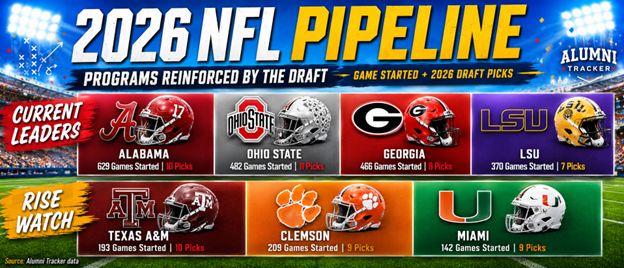
Alabama still looks like the safest bet on the board.The Tide led the country with 629 games started, and the pipeline still runs through quarterbacks, backs, receivers, and pass rushers. Jahmyr Gibbs (Lions) and Derrick Henry (Ravens) gave Alabama real backfield volume. Bryce Young (Panthers) and Tua Tagovailoa (Falcons) kept the quarterback line active. Jameson Williams (Lions), DeVonta Smith (Eagles), and Jaylen Waddle (Broncos) kept Alabama tied to explosive receiver production, while Jordan Battle (Bengals), Xavier McKinney (Packers), Marlon Humphrey (Ravens), Minkah Fitzpatrick (Dolphins), Byron Young (Rams), and Will Anderson Jr. (Texans) carried the defense. Then the draft added another 10 names, headlined by first-rounders Kadyn Proctor (Dolphins) and Ty Simpson (Rams), with Germie Bernard (Steelers) giving the class an early Day 2 receiver and seven more names following behind them. Alabama still looks like the bar here.
Ohio State has a different feel, but the result is similar. The Buckeyes already had one of the strongest NFL bases in the country, and their best active production sat at the glamour spots. Jaxon Smith-Njigba (Seahawks) led the league in receiving yards, won Offensive Player of the Year, helped Seattle win the Super Bowl, and signed the extension that made him the highest-paid receiver in football. C.J. Stroud (Texans) still carries franchise-quarterback responsibility, even with more pressure on him after Houston’s playoff loss to New England put a spotlight on the turnovers that helped sink that run. TreVeyon Henderson (Patriots) already looks like a back New England can build around, Chris Olave (Saints) remains a major part of New Orleans’ offensive ceiling, and Justin Fields (Chiefs) gives the room another quarterback storyline. Behind that active group, Ohio State dropped the biggest class in the country. The Buckeyes had 11 players drafted, four in the top 11, and seven in the first two rounds, with Carnell Tate (Titans), Arvell Reese (Giants), Sonny Styles (Commanders), and Caleb Downs (Cowboys) leading the way. Ohio State is still turning out top-end skill players at a rate nobody else can really match right now.
Georgia still looks like the cleanest defense-to-NFL factory in the country, but the active offensive board is too strong to treat the Bulldogs like a one-side program. Matthew Stafford (Rams) just won MVP and had Los Angeles one win from the Super Bowl. James Cook (Bills) stayed productive as Buffalo’s lead back, George Pickens (Cowboys) turned in a career year and now sits on the franchise tag waiting for his next deal, and D’Andre Swift (Bears), Ladd McConkey (Chargers), and Brock Bowers (Raiders) give Georgia real production at running back, receiver, and tight end. Defensively, Roquan Smith (Ravens) and Quay Walker (Packers) kept the linebacker tradition rolling, while Jordan Davis (Eagles) still gives Georgia real tone up front. Then came another eight-man draft class, with Monroe Freeling (Panthers) going in the first round and Christen Miller (Saints), CJ Allen (Colts), Oscar Delp (Saints), Zachariah Branch (Falcons), Daylen Everette (Steelers), Colbie Young (Bengals), and Micah Morris (Eagles) keeping the flow going behind him. Georgia still feels like the most bankable defense pipeline on the board, but the offensive side has enough established NFL production to keep the whole thing from feeling narrow.
LSU’s case starts with star power. Even in a season where some of the active names ran into injuries or uneven team context, the Tigers still have premium talent at premium positions. Ja’Marr Chase (Bengals) and Justin Jefferson (Vikings) remain two of the best wide receivers in football. Joe Burrow (Bengals) missed more than half the season with a foot injury, came back looking like himself, and still could not drag Cincinnati into the playoffs. Jayden Daniels (Commanders) lost most of his year to injury as Washington slid backward, but he still gives LSU another high-end quarterback chip going into 2026. Defensively, Danielle Hunter (Texans) piled up 15.5 sacks for one of the league’s best defenses, and Derek Stingley Jr. (Texans) stayed exactly what Houston needs him to be on the back end. The draft class behind that group was smaller than Alabama’s or Ohio State’s, but it still had real top-end value: Mansoor Delane (Chiefs) went sixth overall, AJ Haulcy (Colts) and Zavion Thomas (Bears) came off the board on Day 2, and the Tigers still pushed four more names through, including Harold Perkins Jr. (Falcons) and Garrett Nussmeier (Chiefs). LSU may not have the same total-volume look as some of the others, but it still has enough top-shelf NFL talent to stay in that top group.
The Programs on the Rise
Texas A&M feels like the strongest jump case because the shape of the class matched the shape of the active pipeline. The current NFL board is defense-first, with Myles Garrett (Browns) still sitting over everything after a 23-sack season, while Tyrel Dodson (Dolphins) and Edgerrin Cooper (Packers) gave the Aggies linebacker volume, Antonio Johnson (Jaguars) gave them a real takeaway season in the secondary, and Von Miller (Commanders) still carried veteran edge credibility. On offense, De’Von Achane (Dolphins) is the clear centerpiece after a 1,350-yard rushing season with real receiving production on top of it. Then the draft arrived and pushed the whole thing forward. KC Concepcion (Browns) gave A&M a first-round skill player, but the real story was the trench-heavy flood behind him: Chase Bisontis (Cardinals), Cashius Howell (Bengals), Nate Boerkircher (Jaguars), Tyler Onyedim (Broncos), Albert Regis (Jaguars), and Trey Zuhn III (Raiders) all came off the board by the end of Day 2, and the Aggies finished with 10 picks overall, tying the school record. That is how a good NFL base starts to look bigger in a hurry.
Clemson has a live quarterback at the center of its NFL case again. Trevor Lawrence (Jaguars) bounced back with a franchise-record touchdown season and reasserted himself as the offensive face of Jacksonville. Travis Etienne (Saints) re-established himself as the lead back in Jacksonville before signing with the Saints this offseason. Tee Higgins (Bengals) stayed one of the league’s better finishing receivers. On defense, Nate Wiggins (Ravens) made a real second-year jump, A.J. Terrell (Falcons) still gives Clemson a high-end corner name, and Dexter Lawrence (Bengals) remains the kind of interior presence teams still pay for. Then Clemson followed it with one of the most balanced classes in the country. Blake Miller (Lions) and Peter Woods (Chiefs) went in the first round, T.J. Parker (Bills), Avieon Terrell (Falcons), and Antonio Williams (Commanders) followed inside the top 75, and Clemson finished with nine picks, all in the first five rounds. This is what a program on the verge of a jump looks like. The active core is real, and the class behind it hit both sides of the ball.
Miami rounds out the jump group because the class was too big and too top-heavy to ignore. The active board starts with Cam Ward (Titans), who gave Miami a real quarterback anchor with 3,169 passing yards as a rookie, and the defense has enough pass-rush and secondary juice with Kamren Kinchens (Rams), Michael Jackson (Panthers), Jaelan Phillips (Panthers), Gregory Rousseau (Bills), and Calais Campbell (Cardinals) all giving the Hurricanes usable NFL presence. Then the draft class pushed the whole picture into a different tier. Miami had nine players drafted, tied Clemson for the most in the ACC, and landed three first-rounders in Francis Mauigoa (Giants), Rueben Bain Jr. (Buccaneers), and Akheem Mesidor (Chargers). The Hurricanes also put six players in the top 100, added quarterback Carson Beck (Cardinals), and showed a much fuller both-sides-of-the-ball pipeline than the old Miami speed stereotype. If A&M is the trench-heavy jump case, Miami is the athlete-heavy one.
At the conference level, the SEC and Big Ten still own the biggest slice of the NFL board. That part of the story has not changed. What did change in this draft was how many programs beneath the absolute top tier added enough to make the next cycle more interesting. Alabama, Ohio State, Georgia, and LSU still look like the safest bets to keep feeding the league. Texas A&M, Clemson, and Miami look like the programs with the clearest chance to shove their way closer to that group.