

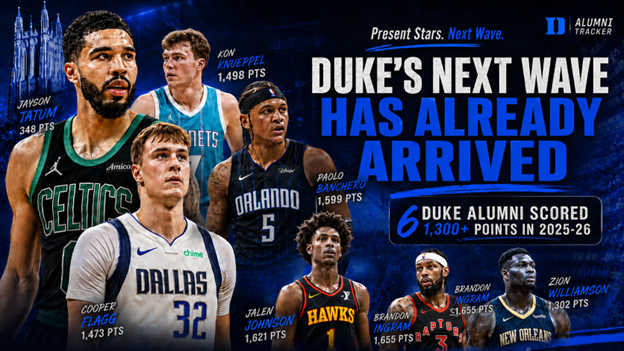
Duke’s next NBA wave is already here, and it is producing at a top-tier alumni level. Explore the full Duke NBA alumni page for season stats and player tracking.
The Blue Devils had six players clear 1,300 points this season, led by Brandon Ingram (Raptors) at 1,655, Jalen Johnson (Hawks) at 1,621, Paolo Banchero (Magic) at 1,599, Kon Knueppel (Hornets) at 1,498, Cooper Flagg (Mavericks) at 1,473, and Zion Williamson (Pelicans) at 1,302. View the full NBA team leaderboard to compare Duke’s scoring output against Kentucky, Arizona, UCLA, Villanova, and more.
Duke’s scoring profile had layers. Ingram and Williamson supplied the established production, Banchero and Johnson carried playoff-level responsibility, and Flagg and Knueppel gave the Blue Devils two rookies who already look like long-term NBA fixtures.
Jayson Tatum (Celtics) remains the biggest active Duke name, but this season showed how much is forming behind him. Ingram and Williamson remain proven NBA scorers, but Flagg, Knueppel, Banchero, and Johnson made Duke’s next group look like the program’s new future..
Duke’s Next Wave Is Already Producing
The clearest sign came in the Rookie of the Year race, where Flagg narrowly beat Knueppel in one of the closest votes under the current format.
Flagg won the award after averaging 21.0 points, 6.7 rebounds, and 4.5 assists for Dallas. He became the second-youngest Rookie of the Year winner behind LeBron James, and he joined Larry Bird, Michael Jordan, and Luka Doncic as the only rookies since the NBA-ABA merger to average at least 20 points, six rebounds, and four assists. He also led Dallas in scoring, rebounding, assists, and steals, making him the only player in the NBA this season to lead his team in all four categories.
The Mavericks were nowhere near the playoff picture, but Flagg still handled a massive role right away. He created offense, played through roster instability, and gave Dallas a clear long-term centerpiece.
Knueppel made the Duke rookie story even stronger. He finished second in Rookie of the Year voting after averaging 18.5 points, 5.3 rebounds, and 3.5 assists for Charlotte. He also made 273 3-pointers, setting the rookie record and leading the league. The Hornets improved by 25 wins, finished 44-38, and reached the Eastern Conference play-in round.
Duke had both sides of the Rookie of the Year race. Flagg gave the Blue Devils the future superstar case. Knueppel gave them another rookie who already looked like a major NBA building block.
Banchero added a different kind of proof. Orlando’s first-round loss to Detroit ended with frustration after the Magic blew a 3-1 series lead, and Banchero was blunt afterward about whether the roster had enough to contend. His individual finish still stood out. After Franz Wagner’s calf injury, Banchero averaged 33.3 points over the final three games and scored 38 in Game 7.
He can be a polarizing superstar. Banchero’s shot selection, efficiency, offensive identity, and defensive consistency remain debated. He could be framed as the NBA’s most complicated star because the flashes are real, but the full superstar profile remains incomplete.
That tension is part of what makes him important in this Duke group. Banchero is not a finished product, but he is a 23-year-old franchise forward who has already carried playoff possessions.
Johnson gave Duke another young forward with playoff exposure. Atlanta’s season became the start of a new roster direction, with Johnson framed as the centerpiece of the Hawks’ next era after the Trae Young trade.
The playoffs showed where Johnson has climbed and where he still has to grow. New York treated him like a primary problem, using Josh Hart as his main defender, loading help toward him, and trying to slow Atlanta’s transition game. Johnson adjusted during the series, becoming more assertive after a slow start in Game 2. During the series, it became obvious that his gravity is real. The Knicks schemed the entire defense around him, which says plenty about how Atlanta now sees him.
The Established Names Still Give Duke Weight
Tatum still gives Duke the cleanest headline résumé.
His season total in the Alumni Tracker table was limited because he was returning from a torn right Achilles, but the production he gave Boston after coming back was a key NBA storyline. Tatum returned less than 10 months after the injury and averaged 21.8 points, 10 rebounds, and 5.3 assists in 16 regular-season games. He then averaged 23.3 points, 10.7 rebounds, and 6.8 assists through the first six games of Boston’s first-round series against Philadelphia.
The ending was rough. Tatum missed Game 7 with left knee stiffness, and Boston blew a 3-1 series lead. But his comeback still reinforced why he remains Duke’s most accomplished active NBA product. Even at 80 to 85 percent, as he described himself, Tatum returned as a high-level playoff player.
The rest of Duke’s established group gave the season more depth. Ingram led Duke’s Alumni Tracker scoring table with 1,655 points for Toronto, giving the Raptors an All-Star scorer before a heel issue complicated his playoff run. Williamson added 1,302 points for New Orleans and gave the Pelicans better availability than he has in several past seasons.
Barrett gave Duke another important Toronto piece, finishing with 1,098 points and helping the Raptors push Cleveland in the playoffs. Carter played real frontcourt minutes for Orlando next to Banchero, giving Duke another rotation player involved in a postseason series. Kennard found late-season value with the Lakers, especially when injuries increased the need for shooting and secondary offense.
That is the strength of Duke’s NBA profile right now. The Blue Devils have Tatum’s résumé at the top, Ingram and Williamson as established scorers, Barrett, Carter, and Kennard in useful rotation roles, and a younger group that is already carrying real responsibility.
Flagg and Knueppel made that obvious in the Rookie of the Year race. Banchero and Johnson showed it in the playoffs. Duke’s future is not sitting a few years away. Explore the full Duke NBA alumni tracker page to see season-long scoring, stats, and player performance.
It is already changing the league.